

GSP Mapping of Alteration Minerals to Locate New Porphyry Copper-Gold Targets in the Chagai Belt, Balochistan.
According to the Geological Survey of Pakistan (GSP) satellite launch report 2019 published in GEOLOGICA-V8-N1.pdf (page 34), twenty-three new exploration targets were delineated as potential porphyry Cu-Au mineralization prospects based on geology maps from false-color composites (1644.0 nm, 2199.5 nm, and 2334.2 nm), SAM results using JPL standard mineral spectra, and Al-OH absorption characteristics in the western Chagai belt, Pakistan. Alterations at three of the newly located geology targets near Saindak, Koh-I-Sultan, and Durban Chah (northeast of Mashki Chah) were thoroughly inspected in the field, and all three targets were confirmed to have strong Cu-Au mineralization. It is also confirmed that stronger Cu-Au mineralization in the Chagai belt is mostly located in areas where Al-OH absorption features tend to shift to longer wavelengths within 2200-2215 nm, e.g., Reko Diq, Durban Chah, and Dasht-I-Goran (close to Mashki Chah).
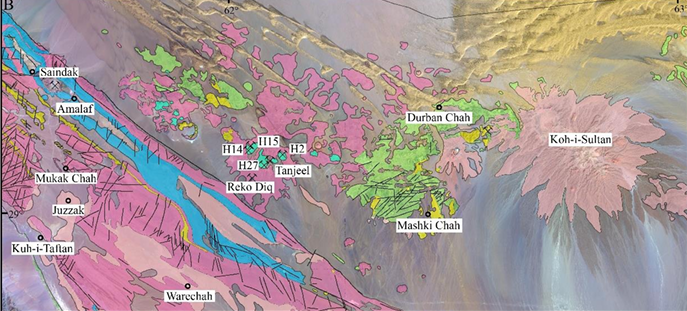
Image courtesy of the Geological Survey of Pakistan (https://geologica.gov.pk/volume8/)
Geology of Chagai Volcano-Magmatic Arc
The Chagai volcano-magmatic arc is highly mineralized, containing 48 known porphyry systems with Cu-Au (Mo) mineralization. Concentric potassic, phyllic, and propylitic zones characterize hydrothermal alteration. Major deposits include the Saindak cluster, with a reserve of 290 million metric tons associated with quartz diorite porphyry, and the world-class Reko Diq complex. Reko Diq is a cluster of prospects within a large eroded stratovolcano with a total resource of 4100 million metric tons. Another important area is the Koh-I-Sultan volcano, which has a system that produces high-sulfidation minerals and other porphyry. In addition to the successful sites for copper, gold, and iron ore, Door-bun Chah, Mashki Chah, Siah Dik, Chigeen Dik, and Dasht-E-Goran are also part of the Western Chagai Belt. Door-bun Chah and Chigeen Dik have been in operational leases for iron ore for a long time, whereas the Siah Dik site has recently been proven for copper-gold deposits and taken over by a Chinese company. The exploration and mining of the Mashki Chah anomaly No. 18 is currently underway.
Expeditious Geology and Exploration History
Numerous national and international entities have explored the area over several decades, as briefly discussed here:
- Early Reconnaissance (1970s): The initial recognition of the belt’s potential was led by the Geological Survey of Pakistan (GSP) and supported by international agencies like UNDP and USGS. They conducted regional mapping and geochemical surveys that identified widespread copper and gold anomalies.
- Detailed Exploration by BHP Minerals (1990s): The most significant and detailed modern exploration work was conducted by BHP Minerals (now BHP) in a joint venture with the Pakistani government in the mid-to-late 1990s.
- Follow-up After BHP’s exit, the state-owned Resource Development Corporation (RDC) and other smaller companies continued their exploration.
We summarize their geology and findings on the Siah Dik and Mashki Chah anomalies as follows:
- Potential: Siah-Dik and Mashki Chah are confirmed to host significant porphyry copper-gold mineralization and high-grade epithermal gold overprints. They are considered advanced exploration prospects. In this regard, the data retrieved from the BHP expeditions remains the cornerstone of all current geological understanding of the Siah Dik and Mashki Chah prospects.
- The overall quality and amount of resources found so far have not been high enough to be considered a “world-class” deposit based on the economic conditions and technology available during the major expeditions. The availability of copper gold is confirmed, but its size and economic viability are yet to be determined.
- Remote Location: The location is no longer remote, as Barrick Gold is working there at Reko Diq, and the Chinese have been producing copper-gold from the Saindak site for more than two decades, and they have recently started excavation and extraction activities at Siah Dik, adjacent to the Mashki Chah Anomaly.
- Security Situation: Law-enforcing authorities have camped in the whole area, and there is no lack of security arrangements.
- Current Status: The areas within AMA 18 & 19 remain under the control of the Balochistan government through the Mines & Mineral Department and RDC. The government of Balochistan has already granted three MLs and one PL to four companies under a consortium, namely, Kaleem Khan & Imran Khan Iron Ore Nokkundi, District Chagai, whereas the Siah Dik anomaly is now (August 2025) successfully operational. It has been assigned to a Chinese company that has started the excavation and extraction process at Siah Dik. The success of Siah Dik has created an environment of competition for investing at the Mashki Chah anomaly.
Integrated Geophysical Exploration of AMA No. 18
The Geological Survey of Pakistan conducted an extensive geophysical investigation as part of its research and development program in 2023. The focus was on exploring metallic minerals on Aeromagnetic Anomalies (AMA-18) in the Nokkundi region of Chagai District, Balochistan. The International Journal of Earth Sciences—Geologica.gov.pk published its findings on July 25, 2024, under Volume 9, Article No. 221. The report discusses the integrated geophysical exploration conducted by the Geological Survey of Pakistan, focusing on the aeromagnetic anomaly-18 in the Chagai Volcano-Magmatic Arc, southwest Pakistan. The study primarily aims to explore iron and copper deposits using various geophysical methods, including magnetic and resistivity techniques.
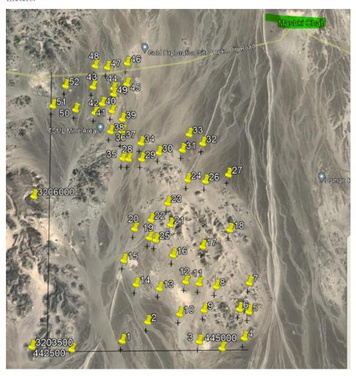
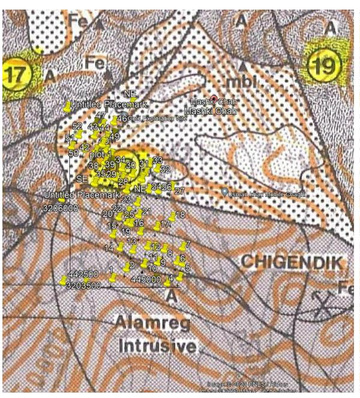
Image courtesy of the Geological Survey of Pakistan (https://geologica.gov.pk/volume9/).
Key Points and Highlights of Mashki Chah Geology
- Study Area and Methods:
- The investigation was conducted in the Nokkundi region of Chagai District, Balochistan, a mineral-rich belt characterized by mafic to felsic volcanic rocks and ironstone intercalations.
- Geophysical methods employed include magnetic surveys and Induced Polarization (IP) Wenner methods. A total of 52 IP lines were surveyed to assess subsurface anomalies.
- Geology Findings:
- The magnetic surveys revealed zones of high chargeability and low resistivity, indicating potential ore bodies. Notably, two promising zones for iron ore drilling were identified within aeromagnetic anomaly-18. A third zone with low magnetic properties but high chargeability was also noted, suggesting diverse mineral compositions.
- The total reserve estimation is about 288,000,000 cubic meters.
- Exploration Recommendations:
- The paper recommends drilling three exploration wells to evaluate the disseminated copper potential in the area. The suggested drill targets are based on the findings from both the magnetic and IP surveys.
- Specific coordinates for drilling locations are provided to explore the identified mineral zones further.
- Geology Context:
- The Chagai region has been recognized for its potential in porphyry copper-gold deposits, with a geological setting that supports significant mineralization.
- The report emphasizes the importance of understanding the geological and geophysical characteristics to enhance exploration success.
- Conclusion:
- The findings from the geophysical surveys suggest promising prospects for mineral exploration, particularly for iron and copper deposits in the Chagai region. The study highlights the need for further exploration and detailed assessments to fully understand the area’s mineral potential.
- Overall, these conclusions provide valuable insights into the mineral potential and distinctive characteristics observed within the surveyed area, guiding further exploration and investigation efforts in targeted zones for potential mineral deposits.
- Sulfide System:
- The drill hole at Aeromagnetic anomaly-18 exhibited a response identical to that of the sulfide system documented in the report. This exploration marks a significant step towards enhancing the understanding of the geophysical characteristics and potential mineral resources present in the area.
- Implications:
- The results of this study have significant implications for future mining activities in the region, potentially leading to the discovery of new mineral resources and contributing to the economic development of southwestern Pakistan. The comprehensive approach combining geophysical techniques provides a robust framework for assessing mineralization in complex geological settings.
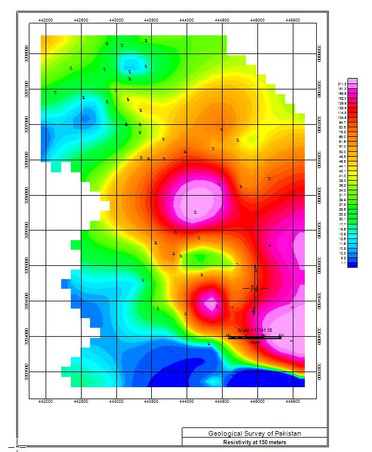
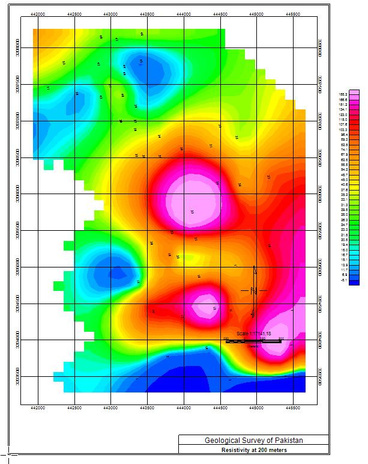
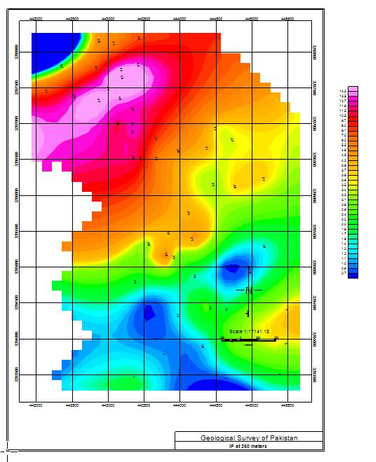
Image courtesy of the Geological Survey of Pakistan (https://geologica.gov.pk/volume9/).